
60 Free Spins No Deposit UK 2026: The Honest Reading of a “Free” Trial
A “60 free spins, no deposit” offer looks like a free trial of an online slot. The catch lives in three places: whether the casino holding it is actually licensed to take UK players, what the casino asks you to do with any winnings before they become withdrawable cash, and whether a self-exclusion you already set covers the promotion. This page works through each, against the Gambling Commission’s public register and against the wagering rules that have applied since 19 December 2025. The aim is to leave a reader with a clear-eyed sense of what the offer is, what it costs, and which of ten well-known GB-licensed brands a comparison actually separates.
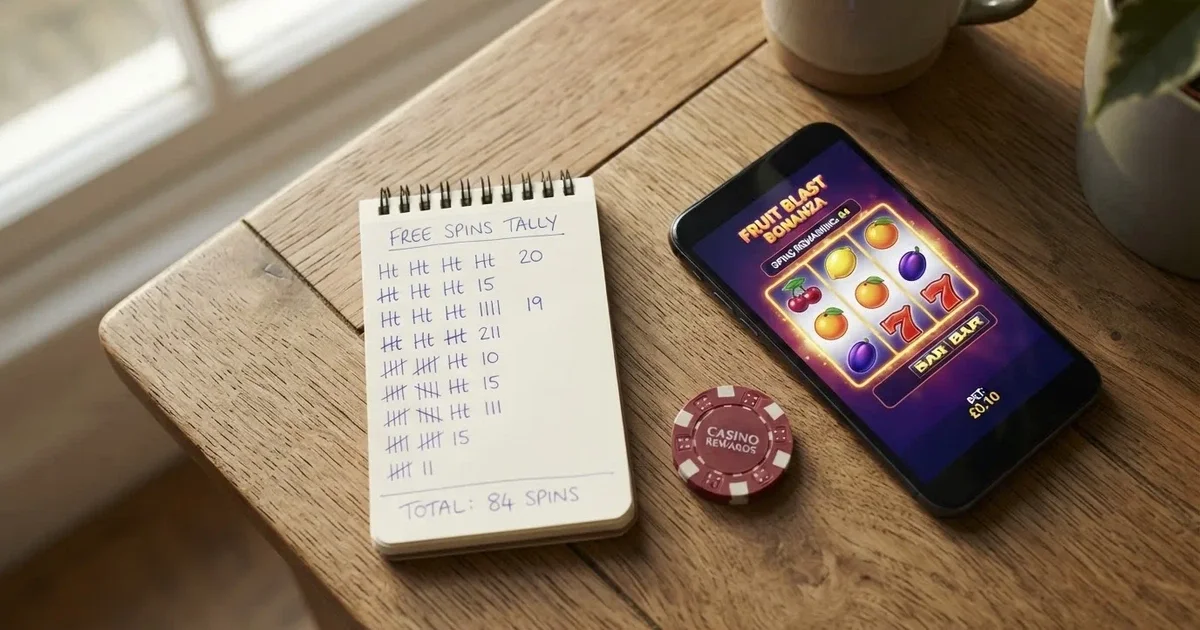
As of 8 November 2026, the data in this article was checked against the Gambling Commission’s public register of gambling businesses.
Table of Contents
- What a “no deposit” spins offer actually is
- Why the Gambling Commission licence is the whole test
- The rulebook a licensed spins offer has to follow
- Responsible gambling tools that apply to a spins offer
- How any winnings actually leave the casino
- Reading a 60-spins offer: the arithmetic behind the wagering cap
- The ten licensed brands, compared on what the register actually shows
- Paddy Power — the listed brand and what the licence confirms
- Unibet — Platinum Gaming as the regulated entity
- Sky Vegas — Bonne Terre Gaming behind the brand
- kwiff — Eaton Gate Gaming and a smaller licence holder
- bet365 — Hillside as the regulated entity behind a household name
- MrQ — Tek Fox Ltd and a focused casino product
- Midnite — Dribble Media Limited behind a newer brand
- Virgin Games — a white-label entry worth noticing
- BetVictor — BV Gaming as the regulated entity
- Grosvenor Casinos — Rank Interactive as the regulated entity
- Choosing between the ten: what the comparison actually separates
- Practical reading before claiming
- The offshore option, named only to be ruled out
- A note on tax
- Frequently asked questions about 60 free spins no deposit offers
What a “no deposit” spins offer actually is
The mechanic is straightforward. A casino credits a fixed number of free rounds on a named slot, usually at a fixed coin value, and any winnings land as bonus funds rather than cash. The first thing to be precise about is that “no deposit” means no deposit is required to receive the spins. It does not mean the winnings are yours unconditionally. A wagering requirement attaches to whatever the spins produce, a maximum-win cap often does too, and the casino can withdraw the bonus balance if the requirement is not met within a stated window. The “free” in the headline covers the spins, not the cash they might produce.

Two design choices are worth noticing. First, the coin value is set by the casino rather than chosen by the player, so the same headline of “60 spins” can mean very different gross stakes depending on the title. Second, the eligible slot is usually a single named game — a casino will not let you run the bonus through the highest-RTP title in its lobby. Both choices belong to the operator, and both shape what the spins are worth before a wagering rule ever applies.
The wider landscape behind those offers is bigger than the ten brands covered below. The Gambling Commission’s public register listed 139 businesses holding an active remote casino operating licence on 18 September 2026. The same register’s domain list tracks every website tied to each licence account, with a status of Active, Inactive or White Label; on that date it held 1065 active and 361 white-label domain entries. A white-label site trades under another company’s licence — the brand on the landing page is not necessarily the licence holder behind the games.
That distinction matters because the operator running the games is the one the Gambling Commission regulates, the one GAMSTOP binds, and the one whose complaints route the player can use. A glossy front end on a domain can sit a layer or two away from the regulated entity. The licence number on the register has a recognisable shape — account-R-number-suffix — and the leading six digits repeat the licence holder’s account number, with the “R” marking a remote (online) licence. Anyone can search the register and confirm that the company running the spins is the company that holds the licence, before signing up.
Why the Gambling Commission licence is the whole test
In Great Britain — England, Scotland and Wales — the Gambling Act 2005 governs online gambling, and the Gambling (Licensing and Advertising) Act 2014 made it a requirement that any operator taking customers in Great Britain hold a Commission licence wherever it is based. A Curaçao, Maltese or Gibraltar licence is not a substitute for taking UK play. Northern Ireland sits outside this regime and is run separately.

The practical consequence is narrow but absolute. If a brand is not on the Commission’s public register as the holder of a remote casino operating licence, taking deposits or running a “60 free spins, no deposit” promotion for players in Great Britain is an offence under section 33 of the Gambling Act 2005, and the player has none of the protections the regime provides — no GAMSTOP binding, no approved alternative dispute resolution (ADR), no Commission complaints route. The Commission disrupts illegal sites through cease-and-desist notices, payment and hosting referrals, and search-engine delisting, but it has no power to block sites at ISP level. The penalty for using an unlicensed site is paid by the player, in the loss of every protection a licensed site has to provide.
A licensed site does several things an unlicensed one cannot. Identity verification is required before the first deposit or any play, a rule in force since 7 May 2019 — the casino asks for name, address and date of birth and checks them against documents. Anonymous play is not possible at a licensed site, even for a no-deposit promotion. The casino binds itself to GAMSTOP, the safer-gambling tools discussed below, and the Commission’s enforcement arm. A reader comparing offers is comparing licensed brands against each other; the unlicensed option is not on the table without walking away from every protection the comparison assumes.
The rulebook a licensed spins offer has to follow
Three rule changes have shaped what a UK 60-spins offer looks like in 2026.
First, the credit-card ban. Since 14 April 2020 the Gambling Commission has banned the use of credit cards to fund gambling across all online and offline products in Great Britain, with a narrow exception for non-remote lotteries paid for face-to-face. Debit cards and bank transfers are unaffected. The ban extends to credit cards routed through e-wallets — you cannot top up an e-wallet with a credit card and then use that balance at a UK-licensed casino. The Commission estimated around 800,000 UK consumers used credit cards to gamble in 2018, and found that 22% of online gamblers who used credit cards to gamble were classed as problem gamblers. The rule matters here because any winnings from the spins, once cleared, need a withdrawal route — and that route cannot be a credit card.
Second, the slot stake limits. Online slots carry a maximum stake per game cycle — £5 for players aged 25 and over (from 9 April 2025) and £2 for players aged 18 to 24 (from 21 May 2025). A “game cycle” is one spin including any gamble feature, so this is a per-spin ceiling rather than a per-session one. The relevant point for a 60-spins offer is that the coin value the casino sets cannot legally exceed the applicable age-tier ceiling. A spin package set at £1 per spin is within the law for any adult player; a package set at £5 per spin is within the law only for those aged 25 and over.
Third, the wagering cap. Since 19 December 2025 wagering requirements on casino bonuses have been capped at 10x the bonus amount, and mixed-product bonuses — for example, “bet on sport, get casino spins” — have been banned. The change is the single most important figure on this page. The pre-2025 norm of 30x, 40x or 65x wagering is gone for any licensed offer, and any promotion still quoting those terms after 19 December 2025 is either offshore or out of date. The 10x ceiling is what the calculations below use.
A handful of further rules matter in passing. Auto-play has been banned since 31 October 2021 — slots must run at a minimum interval of 2.5 seconds per spin, and “losses disguised as wins” (a payout smaller than the stake accompanied by celebratory graphics) are banned. Operators must prompt a customer to set a financial limit before the first deposit, a rule in force from 31 October 2025, and there is no state-set deposit or loss ceiling — operators set their own defaults.
Responsible gambling tools that apply to a spins offer
A no-deposit promotion is still gambling. The same safer-gambling framework that governs a £500 deposit applies to 60 free rounds, and a player who has self-excluded cannot pick up an offer just because no cash changes hands at the point of claiming.
GAMSTOP is the national online self-exclusion scheme, and since 31 March 2020 it has been a mandatory condition of every online operating licence. A player registers with GAMSTOP and chooses an exclusion period of six months, one year or five years; the exclusion cannot be cancelled early. Every GB-licensed online operator, including the ten listed below, must check new sign-ups against GAMSTOP and refuse service to anyone on the register. The offer reaches the player only if the player is not currently excluded. A player who has self-excluded and tries to claim spins at a licensed site will be refused at the registration stage.
A second tier of protection is the financial vulnerability check. Since 28 February 2025 operators have run a light-touch affordability check using public data once a player reaches £150 of net deposits in a rolling 30-day window. A wider, more detailed financial risk assessment has been signalled by the Commission but is not yet in force. The £150 threshold is for cash deposits; no-deposit spins do not push a player past it, but the moment any winnings are converted to withdrawable cash and any subsequent deposits are made, the threshold begins to apply. It is the kind of rule a player reads once and forgets about, until the day it triggers.
The wider safety net is GamCare, the National Gambling Helpline (0808 8020 133), and GambleAware, which fund treatment and research. Operators must display these routes and must offer their own time-out and self-exclusion tools alongside GAMSTOP. The 60-spins offer is not a separate product line that sits outside the framework; it is a small entry point into the same licensed environment, governed by the same rules.
How any winnings actually leave the casino
Once the wagering requirement is cleared, winnings from the spins become a withdrawable balance. Three payment routes matter in this market.
Bank transfer through the UK’s Faster Payments Service is the workhorse. Faster Payments launched in 2008 and is operated by Pay.UK; it runs 24 hours a day, seven days a week, and most payments arrive instantly or within a couple of minutes, though transfers can occasionally take up to two hours. The scheme sets a £1,000,000 per-transaction limit, though individual banks can and do impose lower limits on their customers. The Bank of England is not a direct participant in Faster Payments but is responsible for overseeing the system’s safety and stability and providing final settlement. For casino withdrawals, this is the rail that almost every UK-facing operator uses for the bulk of payouts.
Debit cards are the second standard route. Visa Debit and Mastercard Debit are accepted by every GB-licensed operator, and the credit-card ban means a debit card is the only card type that can fund a UK gambling account. Withdrawals back to a debit card typically clear in one to three working days once the casino has processed them.
Apple Pay has become a familiar deposit route on iPhone, particularly for players who do not want to type card numbers into a casino cashier. Apple Pay was launched on 20 October 2014, initially supporting only US-issued payment cards, and began supporting UK-issued cards on 14 July 2015. Card data is protected through tokenization: the actual card number is replaced by a device-specific tokenised Device Primary Account Number, with a dynamic security code generated for each transaction. In-store purchases use near-field communication (NFC) to communicate with contactless terminals. Apple states that a supported card from a participating card issuer is required to use Apple Pay, and that Apple Pay is not available in all markets. For UK casino deposits this matters because Apple Pay can fund a casino account, but a withdrawal back to Apple Pay is routed to the underlying card and follows debit-card timings — Apple Pay is a deposit rail, not a payout rail.
AstroPay, for readers who use it, is a global digital wallet offering online payments, virtual and physical debit cards, and peer-to-peer transfers. It was founded in 2009 and is headquartered in Uruguay, and spun off its payment-processing business, dLocal, as a separate company in 2016. For UK-facing operators the relevant entity is AstroPay’s UK arm, Larstal Limited, an electronic money institution authorised by the Financial Conduct Authority under the Electronic Money Regulations 2011. AstroPay’s Isle of Man entity, AstroPay Global (IOM) Limited, is licensed by the Isle of Man Financial Services Authority for money transmission. Whether a particular GB-licensed casino accepts AstroPay for deposits and withdrawals is a per-brand question — and the operator cards below mark each subject’s support as no-data precisely because the public register does not record it.
The general sequence, once a spins offer is claimed and played, looks like this: spins are credited, the player runs them on the named slot, winnings land as bonus funds, the wagering requirement is met on those bonus funds (within any time window), the bonus balance converts to real cash, and the player requests a withdrawal through the cashier. Faster Payments is the fastest rail; debit cards take a working day or two longer; e-wallets sit somewhere between. The credit-card option simply does not exist.
Reading a 60-spins offer: the arithmetic behind the wagering cap
The single most useful number on a UK spins offer in 2026 is the wagering multiple. Since 19 December 2025 that multiple is capped at 10x the bonus amount for any licensed operator. The cap does not say what the bonus amount is — that is set by the casino in the offer terms — and the casino’s choice of coin value and eligible slot determines what the bonus can grow to before wagering applies.
To make the cap concrete, take two scenarios against the same 60-spin headline at a £0.10 coin value. If the bonus is credited as the spin value alone, the bonus amount is 60 × £0.10 = £6. At a 10x wagering multiple, the required turnover is £6 × 10 = £60. If the bonus is instead credited as the win amount — that is, the casino tracks what the spins produce and credits that as the bonus — the bonus amount is whatever those 60 spins returned, and the turnover scales with it. The arithmetic that follows is the same in shape; only the input figure changes.
The wider consequence is that a 30x or 40x offer, which was unremarkable three years ago, is now outside the rules. A player who sees one quoted at a UK-licensed site should treat it as a signal the operator has not updated its terms, or that the offer sits outside the casino-bonus framework the cap covers. The same logic in reverse explains why offshore brands still quote those figures — the 10x cap is a UK rule, not a global one.
The honest way to read any no-deposit offer is to ask three questions before signing up: what is the bonus amount the wagering multiple is applied to, what is the multiple, and is there a maximum-win cap on what the bonus can convert to. If any of those three is missing from the terms, the offer is the wrong offer to claim — not because the casino is dishonest, but because the player cannot price what they are accepting. None of the ten operators covered below carry offer terms in the public register; the comparison table is built from licence and domain data, not from bonus values. A reader who wants those numbers needs the operator’s own promotional terms, read carefully.
The ten licensed brands, compared on what the register actually shows
The comparison below sits on what the Gambling Commission’s public register carries for each brand: the licence holder behind the domain, the active remote casino operating licence number, and the domain’s status on the register. Every brand is a GB-licensed operator; the comparison is among equals on that front, and the only columns that move are the holder, the licence number, and whether the domain is active or white-label. Subject support — whether the brand carries a 60 free spins no-deposit offer to UK players at the time of writing — is no-data for every row in this article’s source set, because the public register does not record it. A reader looking for a specific offer needs to check the operator’s own site.
| Brand | Licence holder and GB remote casino licence | Domain status on the register | Subject support |
|---|---|---|---|
| Paddy Power | PPB Games Limited · 039411-R-319335-010 | Active | — |
| Unibet | Platinum Gaming Limited · 045322-R-324275-019 | Active | — |
| Sky Vegas | Bonne Terre Gaming Limited · 065519-R-339675-002 | Active | — |
| kwiff | Eaton Gate Gaming Limited · 044448-R-323408-017 | Active | — |
| bet365 | Hillside (UK Gaming) ENC · 055149-R-331499-004 | Active | — |
| MrQ | Tek Fox Ltd · 060629-R-337532-004 | Active | — |
| Midnite | Dribble Media Limited · 042647-R-321653-022 | Active | — |
| Virgin Games | Gamesys Operations Limited · 038905-R-319430-022 | White-label | — |
| BetVictor | BV Gaming Limited · 039576-R-319370-028 | Active | — |
| Grosvenor Casinos | Rank Interactive (Gibraltar) Limited · 057924-R-334666-005 | Active | — |
The headline reading is that nine of the ten domains sit as Active on the register, with Virgin Games the only white-label entry — Gamesys Operations Limited is the licence holder, and Virgin Games trades under that licence rather than holding its own. For a reader, the practical implication is that any complaint or safer-gambling query against a Virgin Games account is handled through Gamesys, not through a separate Virgin entity. The licence number column is what the public register shows; it is also the line to quote in any correspondence with the Gambling Commission.
A reader scanning this table for “the best offer” is asking the wrong question of it. The register does not list offers, terms, or wagering multiples — and a comparison that pretended otherwise would be inventing the data. The honest comparison is on licence and on the corporate entity that runs the games, with the offer terms fetched separately from each operator’s own promotional page and read against the 10x cap above.
Paddy Power — the listed brand and what the licence confirms
Paddy Power is listed on the Gambling Commission’s public register as an active domain of account 39411, with the active remote casino operating licence 039411-R-319335-010 held by PPB Games Limited. The licence is current on the register. A reader who lands on Paddy Power and wants to confirm the brand they are about to sign up with can search the register for “PPB Games” or the licence number directly; the active remote licence line is the test. There is no record of a 60 free spins, no-deposit offer to UK players in the public register; the operator’s own promotional page is where any current offer is published.
The brand carries the wider Paddy Power group’s reputation for retail and online presence, and the licence number ties the online operation back to PPB Games Limited, a UK-registered company. The single most useful piece of context is that Paddy Power is not a white-label entry — PPB Games holds the licence in its own name, which simplifies the path for any safer-gambling query, complaint or ADR referral.
Unibet — Platinum Gaming as the regulated entity
Unibet (unibet.co.uk) is listed on the register as an active domain of account 45322, with the active remote casino operating licence 045322-R-324275-019 held by Platinum Gaming Limited. Platinum Gaming is the regulated entity, and the .co.uk domain is the GB-facing version of a Nordic-rooted brand. The licence is the test a reader runs: search the register for “Platinum Gaming” or quote the licence number to confirm the brand is what it claims to be.
Unibet has historically run a wide product spread — sportsbook, casino, live casino — and the GB-facing casino is the part a no-deposit spins offer would attach to. The public register does not carry current offer terms, so any 60 free spins promotion would be visible on unibet.co.uk rather than in the register itself. The licence number is the line that matters when a reader writes to the Commission.
Sky Vegas — Bonne Terre Gaming behind the brand
Sky Vegas is shown on the register as an active domain of Bonne Terre Gaming Limited (account 65519), with the active remote casino operating licence 065519-R-339675-002. Bonne Terre is the regulated entity, and Sky Vegas is the casino brand under the Sky corporate umbrella. The licence is active.
Sky Vegas carries a recognisable UK presence through its parent broadcaster, but the regulated entity for the casino is Bonne Terre Gaming. A reader who confirms the licence on the register sees the corporate layer that actually runs the games. Whether a 60 free spins, no-deposit offer is running at any given moment is a question for the Sky Vegas site itself; the register is the licence test, not the offers catalogue.
kwiff — Eaton Gate Gaming and a smaller licence holder
kwiff (Kwiff.com) appears on the register as an active domain of Eaton Gate Gaming Limited (account 44448), with the active remote casino operating licence 044448-R-323408-017. Eaton Gate is a smaller licence holder than the giants above, and the licence number is the test a reader applies. The brand is a GB-licensed operator.
The “smaller licence holder” point matters because every other protection in this article — GAMSTOP, the 10x wagering cap, the £5 and £2 slot stake limits, the safer-gambling tools — applies with the same force to Eaton Gate’s licence as to PPB Games’. There is no exemption for being smaller. A reader who sees a kwiff offer quoted and wants to verify the brand should search the register for “Eaton Gate Gaming” rather than for the kwiff brand name itself; the licence holder is the line that registers.
bet365 — Hillside as the regulated entity behind a household name
bet365 (Bet365.com) is recorded on the register as an active domain of Hillside (UK Gaming) ENC (account 55149), with the active remote casino operating licence 055149-R-331499-004. Hillside is the regulated entity, and bet365 is one of the largest GB-licensed online operators. The licence is active.
The scale of bet365 means the regulated entity is well known on the register, and a reader who searches for “Hillside” or the licence number lands directly on it. The brand carries a casino, sportsbook and games product, and the casino is where any no-deposit spins offer would attach. Whether such an offer is current at any given moment is a question for Bet365.com itself; the register confirms the licence.
MrQ — Tek Fox Ltd and a focused casino product
MrQ (Mrq.com) is filed on the register as an active domain of Tek Fox Ltd (account 60629), with the active remote casino operating licence 060629-R-337532-004. Tek Fox is the regulated entity. MrQ has positioned itself around a slots-and-bingo product rather than a full sportsbook.
A reader comparing MrQ to the wider list is comparing a focused casino brand against multi-product ones. The same register check applies — search for “Tek Fox” or quote the licence number — and the same 10x wagering cap governs any bonus the brand runs. The public register does not carry current offer terms.
Midnite — Dribble Media Limited behind a newer brand
Midnite (Midnite.com) appears on the register as an active domain of Dribble Media Limited (account 42647), with the active remote casino operating licence 042647-R-321653-022. Dribble Media is the regulated entity. The brand is one of the newer GB-licensed casino entries on this list.
The newer-brand point matters because the licence is the test a reader applies regardless of how long the brand has been trading. Midnite’s presence on the register is what makes a no-deposit offer running on its site a UK-regulated offer; without the licence, the offer would be offshore and outside this article. A reader searching the register for “Dribble Media” confirms the brand quickly.
Virgin Games — a white-label entry worth noticing
Virgin Games sits on the register as a white-label domain of account 38905, with the active remote casino operating licence 038905-R-319430-022 held by Gamesys Operations Limited. Gamesys is the licence holder. Virgin Games is the only white-label entry in this comparison.
A white-label entry trades under another company’s licence rather than holding its own, and the practical effect is that any safer-gambling query, complaint or ADR referral is handled through Gamesys Operations Limited, not through a separate Virgin entity. For most readers the practical implication is small — the offer terms and the slot library look the same as they would at any other Gamesys skin — but a reader who wants to know who is regulated should read the licence line and see “Gamesys Operations Limited”. The Gamesys corporate layer carries a long track record of GB-licensed operation across multiple brands.
BetVictor — BV Gaming as the regulated entity
BetVictor (Betvictor.com) is listed on the register as an active domain of BV Gaming Limited (account 39576), with the active remote casino operating licence 039576-R-319370-028. BV Gaming is the regulated entity. The brand has a long history in UK gambling, with the BetVictor name well established.
The wider corporate point is that BetVictor sits on a BV Gaming licence rather than on a separate Victor Chandler entity; the brand name is a trading name, the licence is held by the parent. A reader searching the register for “BV Gaming” finds the licence quickly. Whether a 60-spins, no-deposit offer is current at the casino is a question for Betvictor.com itself.
Grosvenor Casinos — Rank Interactive as the regulated entity
Grosvenor Casinos is found on the register as an active domain of Rank Interactive (Gibraltar) Limited (account 57924), with the active remote casino operating licence 057924-R-334666-005. Rank Interactive is the regulated entity, and Grosvenor’s well-known retail estate is a separate strand of the business; the licence above covers the online casino at Grosvenor Casinos.
The “Rank Interactive (Gibraltar)” line is worth noticing because it shows that an operator based in Gibraltar can still hold a GB licence and serve UK players — the Gambling (Licensing and Advertising) Act 2014 made that the rule. A reader who sees the “(Gibraltar)” suffix and wonders whether the brand is properly licensed has the licence number to quote back. The 10x wagering cap and every other rule in this article apply on the same terms as for a UK-incorporated holder.
Choosing between the ten: what the comparison actually separates
A reader comparing the ten brands on the table above is not choosing between ten offers; the public register does not list offers. The comparison separates brands on three things a reader can actually verify: the licence holder behind the brand, the licence number itself, and the domain status. The licence holder matters because it is the entity any safer-gambling query, complaint or ADR referral runs through. The licence number matters because it is the unique identifier the Gambling Commission uses for the regulated entity. The domain status matters because a white-label entry trades under another company’s licence, which is a corporate fact rather than a quality fact but is still the kind of detail a careful reader wants before signing up.
What the comparison cannot do is tell a reader which brand is running a 60-spins, no-deposit offer at the moment of reading. For that, the operator’s own promotional page is the only source, and the 10x cap above is the rule to read those terms against. A no-deposit offer with a 30x or 40x wagering multiple, quoted at a brand on this list, is either out of date or being misrepresented.
The wider point — and the reason this comparison exists at all — is that a “60 free spins no deposit” headline can sit on top of a regulated offer or an unregulated one, and the difference is paid by the player who claims the wrong one. The licence line is the test, and every brand above passes it. A reader who keeps the test in mind before signing up has done the part of the comparison the public register actually supports.
Practical reading before claiming
Three checks are worth making before any spins offer is claimed, and each takes a minute or two.
First, the licence. The operator’s footer should carry a Gambling Commission licence number; the format is account-R-number-suffix. The reader pastes that number into the Commission’s public register and confirms the licence is active, the operator name matches the brand they signed up with, and the licence type is “remote casino operating”. The three together confirm the brand is regulated for the product being offered.
Second, the wagering terms. The offer’s small print should state the wagering multiple, the eligible slot or slots, the maximum bonus convertible to real cash, and the time window in which the wagering requirement must be met. A multiple above 10x at a GB-licensed casino is a red flag; the rule has been in force since 19 December 2025. A maximum-win cap is standard for no-deposit offers and is not by itself a red flag, but a reader should know what the cap is before claiming.
Third, the self-exclusion status. Anyone registered with GAMSTOP will be refused at the registration stage by every GB-licensed operator. The check is built into the sign-up process. A reader who has previously self-excluded and is now considering returning to gambling should treat that exclusion as still binding until the chosen period has elapsed.
The order matters. A reader who checks the licence first and the wagering terms second has done the part of the work that protects them. The self-exclusion check is automatic at a licensed site, and the only way around it is to use an unlicensed site — which is precisely the option this page argues against.
The offshore option, named only to be ruled out
For completeness: an unlicensed site running a “60 free spins, no deposit” promotion for UK players is operating illegally under section 33 of the Gambling Act 2005. The Commission’s enforcement work targets the operator, not the player, but the cost is paid by the player anyway. There is no GAMSTOP binding, no ADR route, no Commission complaints mechanism, no age or identity verification, and no 10x wagering cap. The Commission disrupts such sites through cease-and-desist notices, payment and hosting referrals, and search-engine delisting, but has no power to block at ISP level.
The honest reading is that an unlicensed offer looks more generous for one reason only — it sits outside the rules a licensed offer has to follow. The reason licensed offers have those rules is that the rules protect the player who claims them. A reader comparing a 30x offshore offer to a 10x licensed one is not comparing two offers; they are comparing an offer to the absence of one.
A note on tax
UK players pay no tax on gambling winnings. The cost falls on the operator, which pays Remote Gaming Duty — a duty raised from 21% to 40% from 1 April 2026 on gross profits from remote gambling. The duty is part of why licensed offers have to work harder to be commercially viable, and it is part of why offer terms at licensed sites are tighter than they used to be. The headline for a player is that no tax is owed on whatever the spins produce, once it has been converted to withdrawable cash.
Frequently asked questions about 60 free spins no deposit offers
What does 60 free spins with no deposit actually mean?
It means the casino credits 60 free rounds on a named slot at a fixed coin value without asking for a deposit first. Any winnings land as bonus funds, not cash, and a wagering requirement applies before those funds become withdrawable. The “no deposit” covers the spins themselves; it does not cover what happens to anything the spins produce.
Are there wagering requirements on winnings from 60 free spins?
Yes. Since 19 December 2025 the Gambling Commission has capped wagering requirements on casino bonuses at 10x the bonus amount for any GB-licensed operator. Older offers quoted at 30x or 40x are either out of date or sit outside the licensed framework. A reader who sees a multiple above 10x at a licensed casino should treat it as a red flag and check the operator’s terms directly.
Is there a maximum win cap on 60 no-deposit free spins?
Most no-deposit spins offers include a maximum-win cap — a ceiling on the bonus amount the wagering requirement applies to, often set well below what 60 spins could theoretically produce. The cap is set by the operator and stated in the offer terms; a reader who does not see one should ask before claiming. The cap is not the same as a maximum stake per spin, which is set by the Commission at £5 for players aged 25 and over and £2 for players aged 18 to 24.
Does GAMSTOP self-exclusion cover a 60 free spins offer?
Yes. GAMSTOP is a mandatory condition of every GB-licensed online operating licence, and a no-deposit spins offer sits inside that framework rather than outside it. A player registered with GAMSTOP for six months, one year or five years will be refused at the registration stage by every operator on this page. The exclusion cannot be cancelled early, and the offer does not become available just because no cash changes hands at the point of claiming.
How long do 60 no-deposit free spins stay valid once credited?
The validity period is set by the operator and stated in the offer terms, typically 24 hours to 7 days from the moment the spins are credited. Unused spins usually expire at the end of that window, and any bonus funds produced may carry their own expiry for the wagering requirement. The exact number is per offer; a reader who cannot find it should not claim.
Must a casino be licensed by the Gambling Commission to offer 60 free spins with no deposit to UK players?
Yes, for any operator taking customers in Great Britain. The Gambling (Licensing and Advertising) Act 2014 made a Commission licence a requirement for taking UK play, regardless of where the operator is based. A Curaçao, Maltese or Gibraltar licence does not substitute. The Commission’s public register is the whole test of whether a brand holds a licence, and unlicensed operators face enforcement action under section 33 of the Gambling Act 2005.