
No-Wagering Casino Sign-Up Offers in the UK: What the 2026 Landscape Looks Like and What an Offer Actually Costs
A “no wagering” label on a casino sign-up offer reads like a free pass. The marketing tends to land there because that is the version of the deal a player keeps without working through. The label is honest as far as it goes, and what it does not cover is most of the picture. This page walks through how such offers are usually structured at UK-licensed casinos, why the headline value tends to be smaller than a wagered offer of the same brand, and what the rest of the cost — in time, in capped winnings, in the bonus terms the small print does add — looks like by the time a player has finished with it.
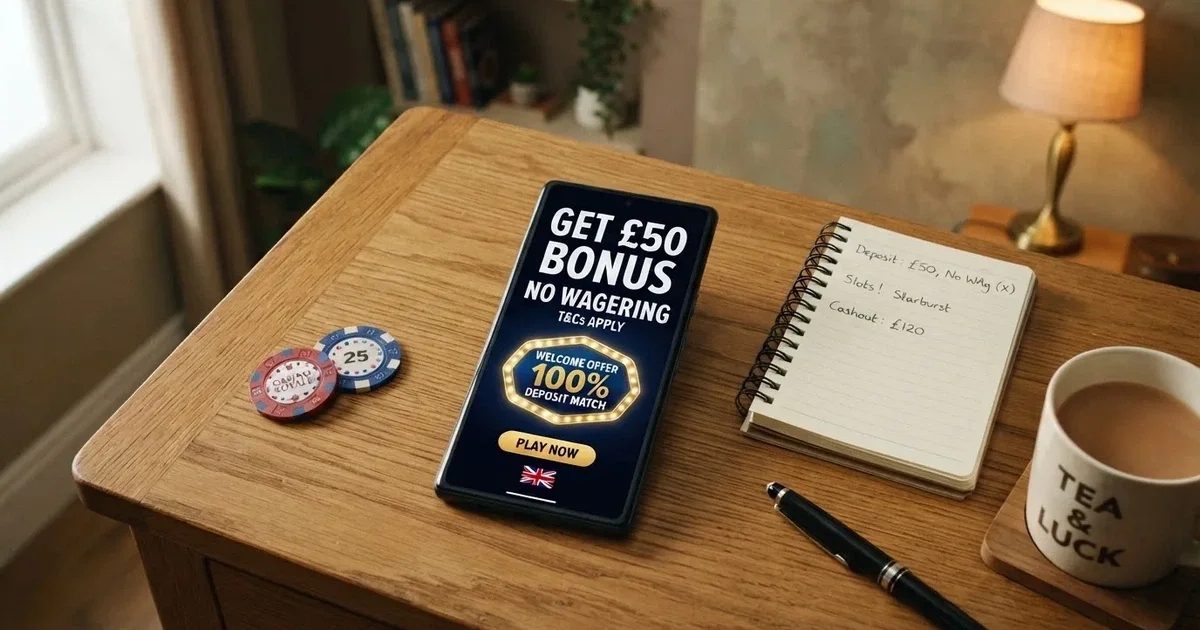
Data current as of 8 November 2026, verified against the Gambling Commission’s public register of gambling businesses.
Table of Contents
- What a no-wagering sign-up offer is, and why the headline is usually modest
- How a sign-up offer is delivered in the UK, and what “fast” actually means
- The licensing jurisdiction every UK sign-up offer sits inside
- What responsible-gambling protections wrap around a UK no-wagering offer
- Payment and payout speed at UK-licensed casinos
- How a no-wagering sign-up offer is priced under the 10x cap
- The 10x wagering cap: a turnover band for the current bonus market
- How a no-wagering offer is laid out on a UK casino’s bonus page
- The ten brands on the register, and what the page can and cannot say about each
- What this page does not say, and what to read elsewhere
- A short list of what to read before claiming any sign-up offer
- Where the limits and the safety net sit around an offer
- What a no-wagering sign-up offer costs the player in time
- Frequently Asked Questions
What a no-wagering sign-up offer is, and why the headline is usually modest
A no-wagering sign-up offer is a promotion that pays out in real cash, withdrawable from the moment it lands in a player’s balance, rather than as a bonus balance that has to be turned over a set number of times before it converts. That is the whole pitch. The other half of the picture — and the half that decides whether the offer is generous or thin — is the size of the headline figure relative to what the same brand would give a player who accepted a wagered bonus instead.

The economics are easy to see once the offer is written out. A casino paying out a £10 no-wagering free spin return has committed, on average, the full £10 to the player, because there is no further play that could claw any of it back. A casino paying out the same £10 as a 35x bonus balance has, in expectation, kept the lion’s share for itself and is paying only the small tail that survives the playthrough. The no-wagering version is a better deal for the player precisely because the casino has priced it that way. Smaller offer, more of it kept. The two are the same trade seen from opposite sides of the counter.
This is the pattern that runs through the UK market in 2026. A wagered welcome package can advertise £100 in bonus funds plus a hundred free spins; a no-wagering equivalent at the same brand is more likely to read £10 in bonus funds, or 25 free spins at a low denomination, or a small cashback on the first session. None of that is a complaint about the offer — it is the arithmetic of pricing a promotion the player will not have to earn back.
The structure of the deal matters more than the brand on the bonus page. Three shapes do most of the work in the UK no-wagering segment:
- A small cash bonus on first deposit. Often in the £5 to £20 range, paid into the withdrawable balance with no playthrough attached.
- Free spins with the spin returns paid in cash. The spin count and per-spin stake are usually modest; anything won is paid as withdrawable cash rather than as bonus funds.
- A net-loss cashback on the first session or first 24 hours. A percentage of net losses, returned as cash, with no turnover attached.
Each of those three is doing the same job for the player. The marketing language around them varies — “real cash”, “no strings”, “keep what you win” — but the structure underneath is the same: small headline, no playthrough, what you see is what you can withdraw. A reader scanning a bonus page for the headline number is going to be unimpressed. A reader scanning the small print for the playthrough line is going to be relieved.
How a sign-up offer is delivered in the UK, and what “fast” actually means
The second half of this search is the speed of sign-up itself. A no-wagering offer that takes three days of verification to claim is, in practice, no faster to enjoy than a wagered offer paid out the same evening. The UK regulator has spent several years tightening the verification rules, and the friction is real even when the brand’s onboarding page is short.
A licensed UK casino cannot allow play — not even a single spin in demo, and certainly not a real-money round — until it has verified the customer’s name, address and date of birth. That verification has been mandatory since 7 May 2019, and the regulator considers it a condition of holding the licence at all. The check itself usually takes a few minutes against a credit-reference or identity database, and a clean match means the player is depositing within the same session.
What slows sign-up is the same set of edge cases that slows any regulated onboarding. A name that does not match the electoral roll exactly, a flat that has changed address in the last six months, an address where the postcode does not resolve — each one pushes the customer into the manual review queue and turns a five-minute signup into a next-day one. The fastest sign-ups at a UK-licensed brand are the ones where the credit-bureau check returns a clean match on the first pass and the deposit rail is one the player has used before. Slower sign-ups are the ones where any of those three break.
For deposits, the rail a player picks has its own time-to-balance. A debit card deposit on Visa or Mastercard typically lands in seconds. Apple Pay, where supported, behaves like a debit card behind the scenes. Bank transfer through the UK’s Faster Payments Service usually arrives within minutes, though transfers can occasionally take up to two hours, and the Faster Payments scheme itself runs around the clock. The point is not that any single rail is uniformly fastest for every player; it is that the fastest onboarding on a licensed UK site is the one where the verification check passes first time and the deposit rail is one the player already trusts.
The licensing jurisdiction every UK sign-up offer sits inside
This is the shelf of the page that the search terms do not name but the player absolutely needs. Every sign-up offer at a brand a UK player is considering sits inside a licensing regime, and the regime decides what the brand has to do before it pays out, what game-side limits the player is playing under, and where the player goes if a payout is disputed.

The regime is the Gambling Commission, the regulator sponsored by the Department for Culture, Media and Sport and operating under the Gambling Act 2005. The Act covers Great Britain — England, Scotland and Wales — and not Northern Ireland, where gambling is regulated separately. Since the Gambling (Licensing and Advertising) Act 2014, the regime has applied on a customer-locating basis: any operator taking bets from customers in Great Britain needs a Commission licence, wherever the operator itself is based. A Curaçao or Malta licence is not a substitute. The point is not that those jurisdictions are illegitimate in their own right; it is that they are not the regime a UK player is protected under.
As of 18 September 2026, the Gambling Commission’s public register listed 139 businesses holding an active remote casino operating licence; the register can be searched online and downloaded in full as CSV or Excel files. The same register’s domain list recorded each website against the licence account that runs it, with a status of Active, Inactive or White Label; on the same date it held 1,065 active and 361 white-label domain entries — a white-label site trades under another company’s licence. A remote casino licence number on the register has the form account-R-number-suffix, where the leading six digits repeat the licence holder’s account number and the “R” marks a remote, online licence.
That register is the whole test of whether a brand holds a UK licence. The licence account on the certificate has to match the licence account on the register, the domain has to be listed against that account, and the licence has to be in active status at the moment the player is signing up. A brand whose domain is on the register as Inactive, or whose account number does not appear at all, is not offering its sign-up under a Commission licence — whatever the footer of its website says.
What a Commission licence obliges an operator to do, in the parts that touch a sign-up offer directly, runs through several licence conditions and codes of practice:
- Identity verification before play. Name, address and date of birth are checked before the first deposit or any play, with no exceptions for bonus offers.
- Participation in GAMSTOP. Every online licence holder is part of the national self-exclusion scheme; a player who has self-excluded cannot open an account.
- Financial limits prompt. Before a customer’s first deposit, the operator has to prompt them to set a financial limit — a step in place from 31 October 2025 — rather than assuming a default ceiling.
- Financial vulnerability checks. These run at £150 of net deposits in a rolling 30-day window, using publicly available data, with the broader financial-risk assessment regime announced but not yet in force.
- Bonus terms caps. Wagering requirements are capped at 10x on any bonus since 19 December 2025, and mixed-product bonuses — a sports bet that pays out casino spins, for example — are banned outright under the same rules.
The point of running through the list is not to recite regulation. It is that each of these conditions changes the shape of a sign-up offer a player is about to claim. The verification step is why a fast signup is sometimes a next-day signup. The GAMSTOP step is why a player who has self-excluded cannot simply move brands. The financial limits prompt is why the first screen after registration asks the player to pick a ceiling. The bonus terms cap is why this page’s calculation can quote a 10x ceiling and treat it as the market norm.
What responsible-gambling protections wrap around a UK no-wagering offer
The shelf a searcher does not type but a regulator and a brand’s licence manager think about every day is the responsible-gambling layer around the offer. The offer is the part the marketing writes; the protection layer is the part the licence requires.
The two regimes the player meets first are GAMSTOP and GamCare. GAMSTOP is the national online self-exclusion scheme. Since 31 March 2020 it has been a mandatory condition of every UK online gambling licence, which means a UK-licensed casino cannot let a self-excluded customer open an account or, if an account already exists, must block access. Self-exclusion periods are six months, one year or five years, and cannot be cut short — a player who signs up for five years is excluded for five years. GamCare runs the National Gambling Helpline and is the referral route for players who want help beyond what GAMSTOP’s exclusion mechanism offers; GambleAware funds treatment and education services across Great Britain.
Both are free, both are confidential, and both run whether the player is at a £5-deposit brand or a £500-deposit one. The offer on the screen has nothing to do with either of them — a player can claim the bonus and then call GamCare the same afternoon — but the protection layer exists because the offer exists, and the offer does not get to ignore it.
The second layer is the deposit limit prompt. From 31 October 2025 a UK-licensed operator must, before accepting a customer’s first deposit, prompt them to set a financial limit on the account. The prompt has to be active rather than a buried toggle; a customer who skips the prompt has to confirm the skip in a way the operator’s compliance file can show. There is no state-set deposit ceiling the limit must hit. What the law requires is that the player has actively chosen a ceiling before the first deposit lands, rather than discovered one only when the cashier refused a top-up.
The third layer is the financial vulnerability check. From 28 February 2025, a UK-licensed operator has to run a financial vulnerability check at the £150 net-deposits-in-a-rolling-30-days threshold, using publicly available data. The check is not a credit check, and it does not leave a footprint on the customer’s credit file. It is a soft signal: if the public data suggests the customer is in a financially vulnerable position, the operator has to intervene, usually with a softer reality check, sometimes with a deposit cap or a cooling-off period. The wider financial-risk assessment regime is on the way but is not yet in force; what is in force today is the £150 threshold check.
The fourth layer is on the game itself. Online slots at a UK-licensed brand carry a maximum stake per game cycle — £5 for players aged 25 and over, in force from 9 April 2025, and £2 for players aged 18 to 24, in force from 21 May 2025. A “game cycle” is a single spin end-to-end, including any feature rounds or gamble options that follow. Auto-play has been banned since 31 October 2021; a single slot spin may not be faster than 2.5 seconds; and losses dressed up as wins — a spin that returns less than the stake but celebrates with a fanfare — are banned. The bonus headline does not mention any of this. The licence enforces it anyway, because the licence is the contract the player signs when they register, whether the player reads the small print or not.
What the protection layer costs the player is, in money, almost nothing. What it costs in time is real: a few extra screens at signup, a deposit-limit prompt, a soft check on big-volume accounts, an ageing check that makes a £2 maximum the rule for players under 25. None of it makes the offer worse. All of it makes the offer safer to walk away from.
Payment and payout speed at UK-licensed casinos
The payment shelf on this page is narrower than it looks, because the payment options at a UK-licensed brand are constrained by two rules the licence enforces: credit cards are banned for gambling, and bonus terms are capped at 10x. The first rule cuts a rail out of the menu; the second rule does not change the rails but it changes how the welcome offer interacts with them.
The credit-card ban has been in force since 14 April 2020. It applies to all online and offline gambling products in Great Britain, with a single exception for non-remote lotteries paid for face-to-face. It covers credit cards routed through e-wallets as well as credit cards used directly. Debit cards and bank transfers were unaffected. The Gambling Commission estimated around 800,000 UK consumers used credit cards to gamble in 2018 and found that 22% of online gamblers who used credit cards to gamble were classed as problem gamblers — figures the regulator used to justify the ban. What it means at the cashier today is that a UK player at a licensed brand is funding the account with a debit card, a bank transfer, an e-wallet loaded from a debit card or bank, or one of a small number of additional rails the brand has integrated.
Apple Pay sits behind the same rule. Developed and operated by Apple Inc., it launched on 20 October 2014 supporting only US-issued payment cards and began supporting UK-issued cards on 14 July 2015. The technology behind it protects card data through tokenisation — the actual card number is replaced with a device-specific tokenised Device Primary Account Number, and a dynamic security code is generated for each transaction. In-store payments use near-field communication to talk to a contactless terminal; on an iPhone with Face ID, a purchase is authenticated by double-clicking the side button, and on models with Touch ID, by double-clicking the Home button. None of that is gambling-specific. The point that matters at a UK cashier is that Apple Pay funds a debit card, not a credit card, and so sits on the right side of the credit-card ban. Whether a particular UK-licensed brand accepts Apple Pay is a brand-level integration question, not a regulatory one.
AstroPay sits on the same side, but as a digital wallet rather than a card tokenisation layer. Founded in 2009 and headquartered in Uruguay, it operates as a global digital wallet offering online payments, virtual and physical debit cards, and peer-to-peer transfers. The UK-facing entity is Larstal Limited, authorised by the Financial Conduct Authority as an electronic money institution under the Electronic Money Regulations 2011. The wider AstroPay group is regulated in the Isle of Man for money transmission, in Brazil as an electronic currency issuer, and in Denmark as an electronic money institution. AstroPay spun off its payment-processing business, dLocal, as a separate company in 2016. AstroPay serves users across markets including Argentina, Australia, Brazil, Canada, Colombia, Denmark, Spain, the United Kingdom, the United States and Uruguay. A UK player funding a casino account through AstroPay is, in regulatory terms, using a FCA-authorised electronic money institution — a status that does not bypass the Commission’s rules but does mean the wallet sits inside its own UK or EU-authorised perimeter.
Bank transfer is the rail that does the most work for larger payouts. Within the UK, bank transfers typically move through the Faster Payments Service, launched in 2008 and operated by Pay.UK. The service runs 24 hours a day, seven days a week, and most payments arrive instantly or within a couple of minutes, though transfers can occasionally take up to two hours. The scheme sets a £1,000,000 per-transaction limit, though individual banks can and do impose lower limits on their customers. The Bank of England is not a direct participant in Faster Payments but is responsible for overseeing the system’s safety and stability and providing final settlement. For the player, the practical consequence is that withdrawals to a UK bank account via Faster Payments are usually same-day and very rarely longer than a few hours, assuming the brand has approved the withdrawal on its side.
What ties the payment shelf back to the no-wagering sign-up offer is the speed at which a player can move from registration to a paid-out balance. A no-wagering offer that pays in cash needs the brand’s withdrawal queue to clear before the player has the money in hand. The Faster Payments ceiling on the receiving end is short. The bottleneck, where there is one, is on the brand’s side: the verification step, the bonus-credit step (which is usually instant on a no-wagering offer), and the operator’s own withdrawal-approval window. The fastest end-to-end in this market is same-day; the slowest legitimate end-to-end at a UK-licensed brand is one to three working days, typically on a first withdrawal where the operator’s verification review is fresh.
How a no-wagering sign-up offer is priced under the 10x cap
The shelf that decides what a no-wagering offer is worth in 2026 is the bonus terms shelf, because the market is now sitting inside a hard regulatory cap. Since 19 December 2025, the Gambling Commission has capped wagering requirements on bonuses at 10x the bonus amount, and has banned mixed-product bonuses outright — an offer that ties a sports bet to a casino spin return is no longer allowed at a UK-licensed brand.
The 10x cap is best read as a ceiling on the worst kind of deal a brand could write, not as the going rate. The going rate at a UK-licensed brand in 2026 is much lower than 10x on welcome offers, and zero on the kind of offer this page is about. The cap matters because it sets the upper bound on how heavy a wagering requirement can be; it does not change what a no-wagering offer is.
A worked example makes the cap concrete. A £100 bonus with the maximum 10x wagering factor attached asks the player to turn over £1,000 before any of the bonus balance converts to withdrawable cash. At an average slot stake of £1 per spin, that is 1,000 spins. At a 2.5-second minimum spin cycle on a UK-licensed slot, that is 2,500 seconds of play, or roughly 42 minutes. At an RTP of 96% — a reasonable working figure for an online slot in the UK market — the expected loss across that turnover is £40. The £100 bonus therefore costs the player £40 in expectation before it converts.
The expected loss is the more honest measure of what a wagering requirement costs, because the turnover figure is a target, not a price. A player who runs hot through the wagering requirement keeps more than the headline bonus; a player who runs cold keeps less. On average across many players, the expected loss above is the right number.
A no-wagering offer of the same £100 headline skips the turnover and skips the expected loss. The £100 lands as cash. The arithmetic the player has to do is whether £100 now, with no further play required, is worth more than £100 in bonus funds minus the expected £40 of further loss.
The answer is the same way for every player in expectation: the no-wagering £100 is worth more. The expected loss is £40 less. That is the gap between the two offers, and it is the single clearest case the page makes for no-wagering offers in general — they cost less in expectation than the equivalent wagered deal, because the wagered deal’s expected loss is the marketing’s price for the larger headline.
What the calculation does not say is that a player who runs very hot through a wagering requirement can do better than £100 cash. The expected value is the average; a single session can sit above or below it. The expected value is also conditional on the player wagering only the bonus amount and not their own deposit; in practice, players usually wager both, which raises the turnover and the expected loss. The arithmetic above takes the lower figure, because the lower figure is the one the regulation addresses — the bonus’s turnover, not the player’s combined turnover.
The 10x cap is, on this shelf, what stops the calculation from getting worse. A pre-cap market with a 35x or 50x wagering factor would multiply that £40 expected loss by three-and-a-half to five times. The cap is not a tightening of generosity; it is a tightening of the worst the market can offer. The no-wagering end of the market was already a better deal than the heavy-wagering end before the cap; the cap narrows the gap by raising the floor on the heavy end.
The 10x wagering cap: a turnover band for the current bonus market
The calculation this page owes the reader is what the 10x cap looks like as a band across the kinds of welcome offers a UK-licensed brand is currently writing. The cap itself is fixed; the bonus amount varies by brand and offer type, and so does the stake the player wagers at.
For a £50 welcome bonus at the maximum 10x wagering factor, the required turnover is £500. At a £1 average stake per spin, that is 500 spins. At a 2.5-second minimum cycle on a UK-licensed slot, the play time is 1,250 seconds, or roughly 21 minutes. At an RTP of 96%, the expected loss is £20.
For a £200 welcome bonus at the maximum 10x wagering factor, the required turnover is £2,000. At a £1 average stake per spin, that is 2,000 spins and roughly 83 minutes of play. At an RTP of 96%, the expected loss is £80.
For a £500 welcome bonus at the maximum 10x wagering factor, the required turnover is £5,000. At a £1 average stake per spin, that is 5,000 spins and roughly 208 minutes, or just under three-and-a-half hours, of play. At an RTP of 96%, the expected loss is £200.
Each band assumes only the bonus amount is being wagered and the rest of the player’s balance is held back. Each band assumes the player is wagering at the average stake rather than the maximum £5 stake a 25-or-over player can place. A player wagering at the £5 maximum would clear the same turnover in a fifth of the spins and a fifth of the time, with the same expected loss — because the expected loss is calculated on turnover and RTP, not on the number of spins.
The lower bound of any of these bands is the no-wagering case. A £50 no-wagering bonus has a required turnover of £0, a spin count of zero, a play time of zero, and an expected loss of £0 on the bonus itself. The cost to the player is the time taken to register, verify, deposit, claim, and withdraw — which is the same time across all of these bands, because the registration and verification step does not change with the bonus type.
That is the practical takeaway from the band: the cap has not changed the time or cost of a no-wagering offer, and the cap has reduced the time and cost of a wagered offer relative to a pre-cap market. The cap is a ceiling on what a brand can ask of the player. The no-wagering offer is the floor — zero turnover, zero expected loss on the bonus, the whole bonus in the player’s withdrawable balance from the moment it lands.
The 10x cap, the 2.5-second spin floor, the £5 maximum stake, the £150 vulnerability-check threshold — these are the conditions the calculation runs inside. A player reading the calculation as a budget for time or money should read it as an estimate of the average case across many spins, not as a guarantee of any single session. The estimate is what the regulation assumes and what the offer is priced against.
How a no-wagering offer is laid out on a UK casino’s bonus page
The bonus page at a UK-licensed brand follows a template that has tightened over the last several years as the regulator has leaned on clearer terms. The template is worth reading once because the structure determines what the player is actually agreeing to.
The first block is the headline. The headline is the line the marketing team writes and the line the player scans for. For a no-wagering offer, the headline tends to read something like “£10 bonus, no wagering” or “25 free spins, winnings paid in cash”. The number is small. The qualifier — no wagering, winnings paid in cash — is the value.
The second block is the eligibility terms. Minimum deposit, payment method exclusions, country restrictions, age verification, GAMSTOP confirmation. Each of these is the operator being explicit about who the offer is for. A minimum deposit of £10 or £20 is typical. Apple Pay and certain e-wallets are sometimes excluded from bonus eligibility — a rule that exists because bonus abuse across e-wallets is easier to automate. The exclusions list is the part of the offer most worth reading.
The third block is the bonus mechanics. For a cash bonus, the deposit is taken, the bonus is credited, and the bonus sits in the withdrawable balance. For free spins, the spins are issued, the player uses them on a named game or small set of games, and the winnings land in the withdrawable balance. For a cashback, the player plays through the qualifying window, and the net loss is calculated and returned.
The fourth block is the fine print. Game weighting — if a bonus can be used on table games as well as slots, and what percentage of the wager counts toward any condition. Maximum cashout caps, which are uncommon on no-wagering offers but worth checking. Time limits, which set a window in which the bonus has to be claimed and used.
What is conspicuously absent on a no-wagering offer, compared to a wagered one, is the wagering requirement section. The whole section is replaced by a single line: “no wagering requirement” or “winnings paid in cash”. That is the value of the offer. The rest of the bonus page is a smaller version of the same template any wagered offer uses.
The way the offer reads on the page is also a check. A bonus page that buries the wagering requirement in the small print or phrases it as “playthrough”, “turnover”, or “rollover” is signalling that the requirement is non-trivial and the brand would rather the player did not notice. A no-wagering offer does not need to bury the term because the term does not exist. The brand that writes “no wagering” in the headline is doing the regulatory work of being clear; the brand that buries it is doing the marketing work of selling.
The ten brands on the register, and what the page can and cannot say about each
This is the shelf a reader skims for. It is also the shelf the most licence-sensitivity sits behind. The list below is taken from the Gambling Commission’s public register, and it carries the licence holder, the GB remote casino operating licence number, and the status of the brand’s domain on the register at the date the register was sampled. It is not a recommendation. Several brands share a single licence holder — Ladbrokes and Paddy Power are different brands but sit under different parent companies on the register, and Ladbrokes, Coral and Gala Bingo all sit under LC International Limited elsewhere on the Commission’s licence list, though only Ladbrokes appears in the research set — and those parent relationships matter when a player is thinking about which entity they are actually dealing with.
For the subject the page is built around — no-wagering sign-up offers specifically — the page has nothing to attach to any of the ten brands. The research brief behind this page returned a “no-data” status for the subject key on every brand listed. That is not a finding about the brands; it is a finding about the research set on this subject. A reader who needs to know whether a specific brand is running a no-wagering welcome offer today needs to check the brand’s own bonus page; this page cannot speak to it.
What this page can speak to is the licence account, the licence number, the domain status on the register, and the parent-company relationship between brands where it exists. That is the minimum a reader comparing brands needs to make a licensing decision, and it is the maximum a reader should ask this page to make on a bonus decision. Below, each brand gets a licence-and-review profile and a verdict that answers what the page can answer: how the brand sits on the register, who runs it, and what to do about it.
| Brand | Licence holder | GB remote casino licence | Domain status |
|---|---|---|---|
| Grosvenor Casinos | Rank Interactive (Gibraltar) Limited | 057924-R-334666-005 | Active |
| Betfred | Petfre (Gibraltar) Limited | 039544-R-319290-010 | Active |
| 32Red | Platinum Gaming Limited | 045322-R-324275-019 | Active |
| BetVictor | BV Gaming Limited | 039576-R-319370-028 | Active |
| William Hill | WHG (International) Limited | 039225-R-319373-015 | Active |
| Virgin Games | Gamesys Operations Limited | 038905-R-319430-022 | White Label |
| Ladbrokes | LC International Limited | 054743-R-330863-014 | Active |
| Paddy Power | PPB Games Limited | 039411-R-319335-010 | Active |
| Betfair | PPB Games Limited | 039411-R-319335-010 | Active |
| Jackpotjoy | Gamesys Operations Limited | 038905-R-319430-022 | Active |
The table is the licence-and-status version of the comparison. The brand reviews below add the licence-account number, the relationship between brands sharing a parent, and the page’s verdict on what the licence profile tells a reader.
Grosvenor Casinos
Grosvenor Casinos, an active domain of Rank Interactive (Gibraltar) Limited (account 57924), operates under the remote casino licence 057924-R-334666-005. Rank is a long-established operator; the Gibraltar base of its parent reflects a common structure among UK-licensed companies from before the 2014 regulatory changes. The licence is the one governing the player’s account.
Regarding this page’s focus, we have no current-offer data specific to Grosvenor to report. Licensing-wise, the domain status is Active, which is the standard of compliance for a site to carry a Commission-approved sign-up deal. Whether that deal currently includes a no-wagering offer is something players should verify on the brand’s site.
Betfred
Betfred operates through Petfre (Gibraltar) Limited (account 39544) under licence 039544-R-319290-010. Petfre is the group’s Gibraltar-registered parent, a setup that doesn’t affect the UK-licensed nature of the brand’s operations. The licence cited is the live regulatory record for the player.
Betfred’s status is Active, meaning the regulatory basics are in place for any bonus offer it might present. As with other brands, the specific welcome deal and its terms are information the reader will find directly on Betfred’s own site. We confirm the licence is active, but the offer-specific comparison is independent of that regulatory status.
32Red
32Red is run by Platinum Gaming Limited (account 45322) under licence 045322-R-324275-019. Platinum is the entity for the Kindred Group in this market. The suffix “-019” on the licence shows the history of reissues over the years.
Status is Active. This brand is a long-standing fixture in the UK, with a clear regulatory profile. As usual, whether a no-wagering welcome bonus is currently live remains a matter for the operator’s own pages; we simply confirm that the licence is correctly registered and live.
BetVictor
BetVictor is operated by BV Gaming Limited (account 39576) under licence 039576-R-319370-028. The licence suffix indicates its regulatory history, consistent with other brands in the sector.
The licence is Active. This brand meets the required regulatory standards for UK operation. We don’t maintain a live bonus list, so readers should check BetVictor’s current promotions page for details on any welcome offers available. Our assessment here is strictly limited to confirming the licence record is accurate and active.
William Hill
William Hill is licensed through WHG (International) Limited (account 39225) under licence 039225-R-319373-015. Following recent corporate ownership shifts, WHG now handles the brand’s UK operations. The account is one of the older, established entries.
The domain is Active. Our review confirms the licence validity. For specific details on any sign-up deals, readers are encouraged to consult William Hill directly; our focus remains on ensuring the regulatory facts are sound.
Virgin Games
Virgin Games sits on the register as a white-label domain of account 38905, with the GB remote casino operating licence 038905-R-319430-022 held by Gamesys Operations Limited. White-label status on the register means the brand trades under another company’s licence — in this case Gamesys’s — rather than holding its own. Virgin Games does not hold its own Commission licence; it operates under Gamesys Operations Limited’s licence. That does not weaken the licence a player signs up under, because the licence on the register is the licence that governs the player’s protection. It does mean that disputes, complaints, and ADR routes are with Gamesys as the licence holder, not with Virgin Games as the brand. The 38905 account is the licence account, and the 038905-R-319430-022 licence is the live licence. Jackpotjoy sits on the same account and the same licence, as the next entry shows.
For the subject of this page, the verdict on Virgin Games is that the licence is in place, the brand is white-label on Gamesys’s licence, and the bonus-page question is on the brand’s own site. The white-label structure is the part worth knowing because it tells the player who is actually regulated.
Ladbrokes
Ladbrokes is managed by LC International Limited (account 54743) under licence 054743-R-330863-014. LC International is a major player, operating multiple UK-facing brands. Understanding this parent relationship is useful when comparing brands, as they often fall under the same compliance oversight.
The licence is Active. Our role is to verify the regulatory standing; readers should visit Ladbrokes’ bonus page for the most current information regarding welcome promotions. We confirm the licence is in order.
Paddy Power
Paddy Power operates under PPB Games Limited (account 39411), with licence 039411-R-319335-010. PPB Games is the parent company that also hosts Betfair, meaning both brands share the same compliance structure and licence account.
With an Active domain status, Paddy Power meets the necessary regulatory requirements. We verify that the licence is live. Readers looking for specific welcome bonus details should consult the brand’s site, as our analysis is focused on confirming the legitimacy of the operator’s licence.
Betfair
Betfair also uses PPB Games Limited (account 39411), sharing licence 039411-R-319335-010 with Paddy Power. The licensing record is identical.
Betfair is Active. Given that Betfair and Paddy Power share a licence, readers should note that their compliance frameworks are linked. For the current bonus offers, please refer to Betfair directly. Our task here is to confirm the regulatory credentials, which are verified as active.
Jackpotjoy
Jackpotjoy is licensed through Gamesys Operations Limited (account 38905) under licence 038905-R-319430-022, the same account used by Virgin Games. Note that Virgin Games is a white-label brand on this licence, while Jackpotjoy is a direct entry.
The licence is Active. This allows players to verify the regulatory standing clearly. For information on specific welcome deals, we direct readers to Jackpotjoy’s own promotional materials. The licence itself is sound and active.
What this page does not say, and what to read elsewhere
The shelf that comes last on a comparison page is the one a reader looks for after skimming the rest. This page has tried to keep that shelf small.
The page does not say which brand is running the best no-wagering offer in 2026. The research set behind this page did not return any brand-specific no-wagering bonus terms on the brands in §6, and the page does not invent them. A reader who wants a current answer to that question needs to look at each brand’s own bonus page, where the offer terms are written down, and the offer terms are what the player signs up to.
The page does not say which brand is the safest, which brand pays out fastest, or which brand has the best game library. Those questions belong to other comparisons. The fastest payout time at a UK-licensed brand is constrained by the brand’s verification queue and withdrawal approval, not by the rails themselves — most UK bank transfers via Faster Payments are same-day once the brand has approved the withdrawal — and the page has nothing to add on top of that constraint for the brands listed.
The page does say which brands sit on the public register as active, which licence account each brand is held under, and which brands share a parent. That information is what the licence is for, and it is the comparison this page can stand behind with the research it has.
For the bonus offer itself, the page says what a no-wagering offer is, what its structure looks like, what the 10x cap means for the wagered version of the same offer, and what the cost difference between the two is in expected terms. The reader’s job after that is to look at the offer on a brand’s bonus page, decide whether the headline number matches the small print, and decide whether the offer is worth the time the registration will take.
A short list of what to read before claiming any sign-up offer
The point of this page is not to send the reader to a brand. It is to send the reader to a brand’s bonus page with the questions already in mind. Five questions cover most of what a player needs to ask:
- What is the bonus paid in — withdrawable cash, or bonus funds that need a wagering multiple? A no-wagering offer pays in cash; a wagered offer pays in bonus funds.
- Is there a minimum deposit, and does the deposit method affect eligibility? Some e-wallets and some prepaid cards are excluded from bonus eligibility.
- Are free spins locked to one game, or can the player choose? A no-wagering free-spin offer tends to lock the player to one or a small set of games.
- Is there a maximum cashout cap? Uncommon on no-wagering offers but worth checking.
- Is there a time limit on claiming or using the bonus, and what is it? Most offers have a 7-day or 30-day window.
The questions are not a script the player reads to a brand. They are the questions the player reads on the bonus page, before the bonus is claimed. The marketing on the same page will answer all five; the answers a player should trust are the ones written in the small print, not the ones in the headline.
Where the limits and the safety net sit around an offer
The player protection regime that wraps around a UK-licensed casino’s sign-up offer is the same regime regardless of bonus type. A no-wagering offer does not exempt the player from GAMSTOP, from the deposit-limit prompt, from the financial vulnerability check, or from any of the game-side rules. The offer is the part the brand writes; the regime is the part the regulator writes.
The deposit-limit prompt is the first thing a player meets after registration. The brand has to ask the player to set a limit before the first deposit. A player who skips the prompt and confirms the skip is, on the brand’s compliance file, an informed choice. The limit is not a state-set ceiling; it is the player’s own ceiling.
The 18-24 stake limit is the second thing to remember for younger players. The £2 maximum stake per game cycle applies to 18-24-year-old players regardless of what the slot itself accepts. A player in that age bracket who tries to place a £5 stake is rejected by the game, not by the cashier.
GAMSTOP is the third thing, and the most absolute. A player who has self-excluded cannot open an account at any UK-licensed brand. Self-exclusion runs for six months, one year, or five years, and cannot be cancelled early. There is no cooling-off period within the self-exclusion. The exclusion is the contract.
The financial vulnerability check at the £150 net-deposit threshold is the fourth thing, and the most recent. The check runs against publicly available data — not a credit check, no footprint on the customer’s credit file — and triggers a soft intervention if it returns a vulnerable-position signal. A player who sees the check fire is not being punished; the brand is being told to ask whether the player’s gambling is still in budget.
GamCare and the National Gambling Helpline are the fifth thing, and the only one a player calls rather than configures. GamCare runs the helpline, and GambleAware funds treatment and education services. Both are free, both are confidential, and both are reachable regardless of which brand the player is registered with.
The protection regime is the reason this page’s calculation can talk about expected loss without softening the language. The regime is the same regime whether the bonus is heavy or light, and the player sits inside it whether they read the small print or not.
What a no-wagering sign-up offer costs the player in time
The shelf that closes the comparison is the cost a player actually pays, and the cost is mostly time. The money is small; the time is real.
A clean registration at a UK-licensed brand — credit-bureau check passes first time, debit card deposits immediately, no e-wallet exclusion — runs from a few minutes for the form to a few more minutes for the verification, then straight into the bonus. A slow registration — address does not match the electoral roll, the player needs to upload proof of address, the proof has to be reviewed manually — runs from registration form to next-day play.
The bonus itself, on a no-wagering offer, takes no further time. The player claims it, the bonus lands in the withdrawable balance, and the player can withdraw or keep playing. There is no playthrough to clear. There is no expected-loss budget to set against the bonus. The whole time-cost of a no-wagering offer is the time-cost of registration.
For comparison, the time-cost of a £100 wagered welcome offer at the maximum 10x wagering factor is roughly 42 minutes of spin time at £1 average stake and the 2.5-second minimum cycle, with an expected loss of around £40. A player who runs hot through the wagering requirement keeps more than the headline bonus; a player who runs cold keeps less. The expected time-cost is 42 minutes; the expected money-cost is £40.
A no-wagering offer trades that 42 minutes and £40 expected loss for the time-cost of the registration alone. The trade is not always worth making — a £10 no-wagering bonus for 30 minutes of registration is a worse deal than the player would get on a wagered offer with a higher headline — but the trade is the trade, and the calculation is what this page runs.
Frequently Asked Questions
How do casino sign-up offers with no wagering actually work?
A no-wagering sign-up offer pays out as real cash the moment the bonus is credited, with no playthrough attached. The headline value tends to be small — often £5 to £20 in bonus funds or 10 to 50 free spins at a low denomination — because the brand is paying the full amount rather than the average of what survives a wagering requirement. The player keeps what they win, withdrawable from the moment it lands, subject only to the operator’s standard verification and withdrawal checks.
Which UK casino has the fastest sign-up process for claiming an offer?
The fastest sign-ups at a UK-licensed casino are the ones where the credit-bureau identity check passes first time and the deposit rail is one the player has used before. A clean match usually means the player is depositing within the same registration session. Where the match fails — a recent address change, a name spelling mismatch, a non-resolving postcode — the player is pushed into the manual review queue, and a same-session signup becomes a next-day one. No brand in the research set was tagged with a specific sign-up-time figure on this subject.
Are no-wagering sign-up offers usually smaller than offers with wagering attached?
Yes, in expectation they cost the operator more per pound of headline, so the headline is set lower. A £100 no-wagering bonus commits the full £100 to the player, while a £100 bonus at a 35x wagering factor keeps most of the bonus in house and pays only the small tail that survives the playthrough. The no-wagering offer is therefore a better deal in expected terms — smaller headline, more of it kept — but a worse headline for marketing.
Can a no-deposit sign-up offer also carry no wagering requirement?
Yes. A no-deposit bonus — the kind that credits a small bonus or a handful of free spins without a deposit — is usually paired with either a heavy wagering factor or a no-wagering structure. The no-deposit, no-wagering combination exists in the UK market, but the headline value is small for the same reason no-wagering offers in general are smaller: the brand is paying out the full amount.
What should a player check before assuming a sign-up offer has zero wagering?
Check the bonus terms page for the wagering requirement line. A no-wagering offer states the absence plainly — “no wagering”, “winnings paid in cash”, “real cash” — and does not bury the term. A wagered offer phrases it as “wagering”, “playthrough”, “turnover”, or “rollover”, often in the small print. Also check the game-weighting rules, the maximum cashout cap, the time limit on the bonus, and the deposit-method exclusions.
Do UK casino sign-up offers change from month to month?
Yes, regularly. Welcome offers at UK-licensed brands are rewritten by the operator’s marketing and compliance teams on cycles that vary from brand to brand, often monthly or seasonally. A reader who wants the current offer for a specific brand needs to look at the brand’s own bonus page, where the terms in force at the moment of registration are the ones that apply.